
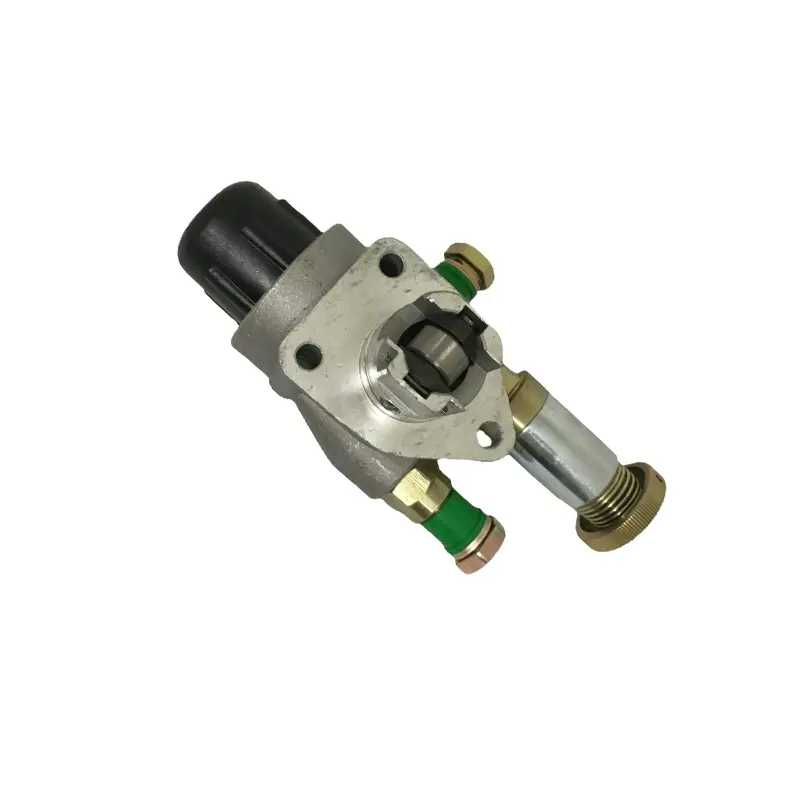

The 200V98130-0579 Ferrule Type Straight Fitting is a high-precision fluid connection component engineered for critical pneumatic and hydraulic circuits in Howo/Sitrak truck parts braking, suspension, and auxiliary systems. Featuring an M14x1.5 metric thread interface and NW10 nominal bore diameter, this straight fitting provides a secure, leak-free connection between rigid tubing and mating components in medium-pressure applications up to 35 bar. The ferrule-type design employs a compression sleeve mechanism that creates a metal-to-metal seal between the fitting body and the tubing, eliminating the need for O-rings, sealants, or thread tape in the primary sealing path. The fitting body is manufactured from high-grade zinc-plated carbon steel conforming to DIN 2353 standards for 24-degree cone compression fittings, providing excellent corrosion resistance and mechanical durability. The precision-machined cone seat and ferrule geometry ensure consistent, repeatable sealing performance across thousands of assembly cycles, making this fitting a reliable choice for both original equipment installation and field service replacement.

Ferrule Type Straight Fitting
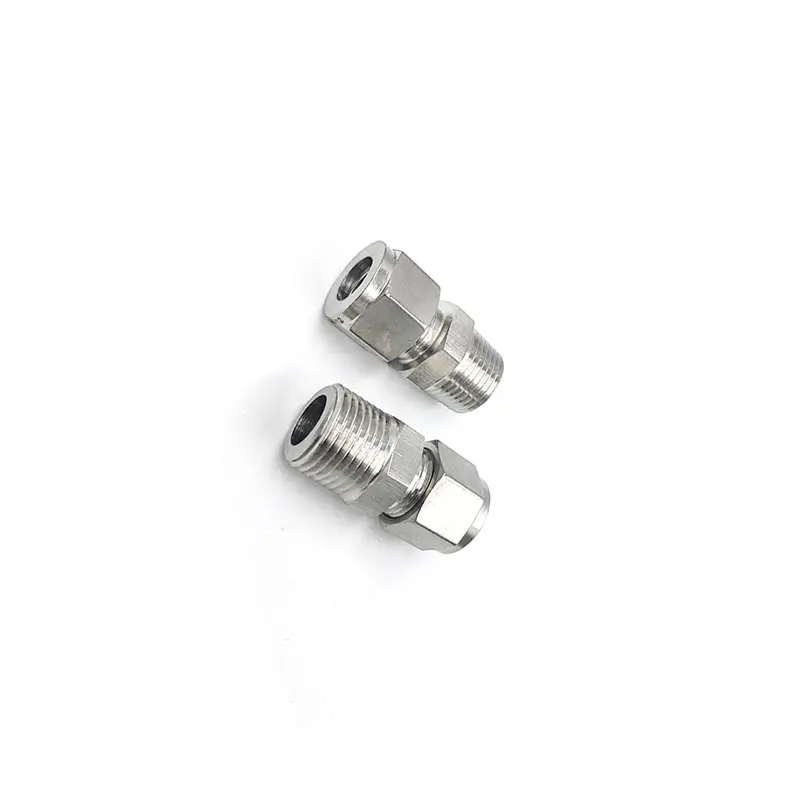
Прямой фитинг с обжимным кольцом
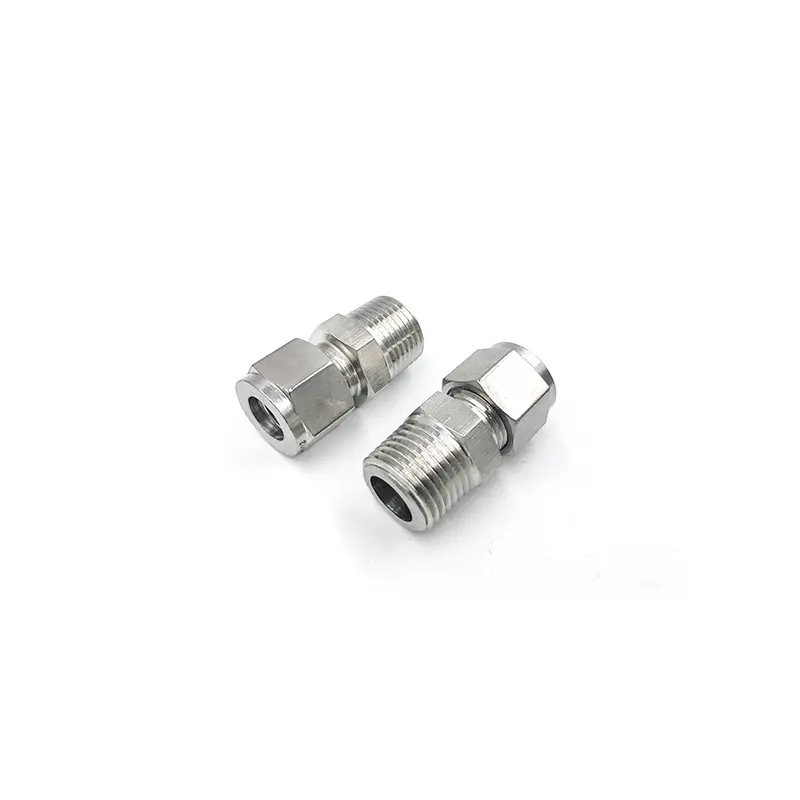
Racor recto tipo férula
The ferrule type straight fitting employs the industry-standard 24-degree cone compression sealing principle as defined by DIN 2353 and ISO 8434-1. When the fitting nut is tightened, the precision-machined ferrule is driven axially along the cone seat, causing the cutting edge of the ferrule to bite into the outer surface of the tubing while the rear portion of the ferrule simultaneously grips the tube. This dual-action mechanism creates a primary metal-to-metal seal at the cone interface and a secondary mechanical grip that prevents tube pullout under vibration and pressure pulsation. The 24-degree cone angle has been optimized over decades of industrial application to provide the ideal balance between sealing force generation and ease of assembly, requiring moderate tightening torque while achieving reliable sealing at pressures up to the burst rating of the connected tubing. The M14x1.5 thread provides sufficient thread engagement to develop the required preload without risk of thread stripping, while the NW10 bore size accommodates 10mm outer diameter tubing with sufficient wall thickness for pressure containment.
The fitting body and nut are manufactured from free-cutting carbon steel conforming to the relevant material specifications for hydraulic and pneumatic fittings. After machining, the components undergo a zinc electroplating process with a minimum coating thickness of 8 microns, followed by a chromate conversion treatment that provides a distinctive yellow or clear passivation layer. This surface treatment system delivers effective corrosion protection in the underbody and chassis environments typical of heavy-duty truck applications, resisting the effects of road spray, salt, mud, and humidity. The zinc plating also provides galvanic protection, sacrificially corroding in preference to the underlying steel substrate if the coating is scratched or damaged during installation. The chromate conversion layer enhances the corrosion resistance of the zinc and provides an excellent surface for paint adhesion if the fitting is to be overcoated during vehicle assembly. Accelerated salt spray testing per ISO 9227 has demonstrated corrosion resistance exceeding 200 hours to white rust and 400 hours to red rust for this coating system.
The ferrule type straight fitting is rated for continuous operation at working pressures up to 35 bar (approximately 500 psi) in pneumatic applications and 160 bar in hydraulic applications with appropriately rated tubing, with a safety factor of 4:1 against burst pressure. The actual pressure rating in any specific application is determined by the lowest-rated component in the assembly, typically the tubing rather than the fitting. The fitting maintains its sealing integrity across a temperature range of -40°C to +120°C for standard applications, with the capability for brief excursions to +150°C during conditions such as engine compartment heat soak. At low temperatures, the zinc-plated steel maintains adequate ductility to prevent brittle fracture, while the ferrule grip on the tubing remains secure despite differential thermal contraction between the steel fitting and the connected tubing material. At elevated temperatures, the fitting maintains its mechanical properties and the zinc plating remains adherent without blistering or flaking, ensuring continued corrosion protection and sealing performance.
One of the significant advantages of the ferrule-type compression fitting design is its ease of assembly and reusability. Unlike flared fittings that require specialized tube flaring tools and are typically single-use, the ferrule fitting can be assembled using standard open-end wrenches and can be disassembled and reassembled multiple times without loss of sealing performance. The fitting is designed to be assembled by sliding the nut and ferrule onto the tube, inserting the tube into the fitting body until it bottoms against the internal tube stop, and then tightening the nut to the specified torque or number of turns. The initial tightening causes the ferrule to bite into the tubing, creating the seal and grip. On subsequent reassemblies, the ferrule returns to its previously established position on the tube, and the same tightening torque or turn count will re-establish the seal. This reusability is particularly valuable during vehicle maintenance and repair operations, where components may need to be removed and replaced multiple times during troubleshooting or system modification without requiring the replacement of every fitting in the system.
| Parameter | Specification | Standard |
|---|---|---|
| OEM Part Number | 200V98130-0579 | Howo Internal |
| Product Type | Ferrule Type Straight Fitting | — |
| Fitting Standard | 24° Cone Compression Fitting | DIN 2353 / ISO 8434-1 |
| Thread Size | M14 x 1.5 | ISO 261 |
| Nominal Bore | NW10 (10 mm) | — |
| Body Material | Free-Cutting Carbon Steel | DIN EN 10277 |
| Surface Treatment | Zinc Electroplated with Chromate Passivation (8 μm min) | ISO 2081 |
| Tube Outer Diameter | 10 mm | — |
| Pneumatic Working Pressure | 35 bar (continuous) | — |
| Hydraulic Working Pressure | 160 bar (continuous) | — |
| Operating Temperature | -40°C to +120°C (continuous), +150°C (intermittent) | — |
| Wrench Size (Body) | 19 mm | — |
| Tightening Torque | 35 – 40 Nm | — |
| Vehicle Compatibility | Howo A7, Howo T7H, Howo MAX, Sitrak C7H, Sitrak G7 | — |
Proven Sealing Reliability in Demanding Environments: The 24-degree cone compression fitting design has been proven through billions of successful installations across automotive, industrial, and mobile hydraulic applications worldwide. The metal-to-metal seal eliminates the potential failure modes associated with elastomeric seals, including chemical degradation, compression set, thermal aging, and extrusion under pressure. In the specific context of Howo and Sitrak truck pneumatic and hydraulic systems, the ferrule type straight fitting has been validated through extensive vehicle-level testing that includes pressure pulsation cycling, thermal shock, vibration exposure, and corrosive environment simulation. The fitting consistently maintains leak-tight performance throughout these test sequences, providing confidence that it will perform reliably in the actual operating conditions encountered by trucks in global service.
Dimensional Interchangeability with Industry Standards: The ferrule type straight fitting is manufactured to the dimensional requirements of DIN 2353 and ISO 8434-1, ensuring complete interchangeability with fittings from other manufacturers that also conform to these standards. This standardization provides flexibility in the supply chain, allowing fleet operators and repair facilities to source compatible fittings from multiple suppliers if necessary. However, it is important to note that while the dimensional interface is standardized, the specific material specifications, surface treatment quality, and manufacturing precision of genuine OEM fittings are controlled to tighter tolerances than the minimum requirements of the standard. This ensures that genuine OEM fittings consistently deliver the sealing performance and durability expected in Howo and Sitrak truck applications, even in the most demanding operating conditions.
Simplified Installation and Reduced Assembly Errors: The ferrule-type compression fitting design reduces the opportunity for assembly errors compared to alternatives such as flared fittings or welded connections. The assembly process is straightforward: insert the tube, tighten the nut. There is no need for specialized tube preparation equipment, no risk of incorrect flare geometry, and no requirement for welding certification or post-weld inspection. The fitting is designed to be assembled using the “turn-count” method, where the nut is tightened a specified number of flats or turns from the finger-tight position, eliminating the need for a torque wrench in many applications. This simplicity reduces the skill level required for correct assembly and minimizes the risk of both under-tightening, which can result in leaks, and over-tightening, which can damage the fitting or tubing. For fleet maintenance operations where technicians may have varying levels of experience and training, this foolproof assembly characteristic is a significant advantage.
Comprehensive Quality Assurance and Traceability: Every production batch of the ferrule type straight fitting is subjected to a comprehensive quality assurance program that includes dimensional inspection of critical features such as thread form, cone angle, and bore diameter; material verification through spectrographic analysis; surface treatment quality assessment through coating thickness measurement and salt spray testing; and functional testing through proof pressure and burst pressure testing on sample fittings from each batch. The manufacturing process is governed by a control plan that identifies all critical characteristics and specifies the inspection methods, sampling frequencies, and acceptance criteria for each. Production lot traceability is maintained from raw material receipt through finished product shipment, enabling rapid identification and containment of any quality issues that may arise. This level of quality assurance provides confidence that every fitting meets the same high standards of performance and reliability.
Proper tube preparation is essential for achieving a reliable seal with the ferrule type straight fitting. Begin by cutting the tubing to the required length using a tube cutter designed for the tubing material, ensuring a clean, square cut perpendicular to the tube axis within 0.5 degrees. Deburr the inside and outside of the cut end using a deburring tool, taking care not to remove excessive material or create a chamfer that could affect the ferrule seating. The tubing surface in the area where the ferrule will grip must be free from scratches, corrosion, paint, or other surface contamination. For steel tubing, the surface should be clean and bright; light surface rust can be removed with fine emery cloth, but deeply pitted or corroded tubing should be replaced. Slide the nut and then the ferrule onto the prepared tube end, ensuring the ferrule is oriented correctly with the cutting edge facing the fitting body. Insert the tube fully into the fitting body until it positively stops against the internal tube shoulder. While holding the fitting body stationary with one wrench, tighten the nut approximately 1.5 turns from the finger-tight position using a second wrench. For critical applications, use a torque wrench to verify the final tightening torque is within the specified range of 35-40 Nm.
Leak detection and preventive maintenance of ferrule type straight fittings should be incorporated into the vehicle’s regular inspection schedule. For pneumatic systems, the most effective leak detection method is the application of a soap solution or commercial leak detection spray to each fitting connection, with the system pressurized to its normal operating level. The formation of bubbles indicates a leak that requires attention. For hydraulic systems, visual inspection for fluid weeping or accumulation around the fitting is the primary detection method. If a leak is detected, first verify that the nut is tightened to the specified torque before assuming the fitting is defective. Many apparent fitting leaks are actually the result of insufficient tightening rather than component failure. If re-tightening does not resolve the leak, the fitting should be disassembled and inspected for damage to the cone seat, ferrule, or tubing surface. The fitting should be inspected for signs of corrosion, mechanical damage, or thread deformation during every preventative maintenance event. Fittings showing significant corrosion or mechanical damage should be replaced promptly to prevent in-service failure.
The ferrule type straight fitting is used in multiple pneumatic and hydraulic systems throughout Howo and Sitrak heavy-duty trucks. The primary applications include the air brake system, where it connects nylon or copper tubing between the air compressor, air dryer, reservoir tanks, brake valves, and brake chambers. It is also used in the air suspension system for connections between the air springs, leveling valves, and control solenoids. In the transmission system, it may be used for cooler line connections and shift actuator air supply lines. Additional applications include the exhaust brake and engine brake pneumatic circuits, the cab tilt system, the seat air suspension, and various auxiliary air systems for trailer connections and onboard equipment. The M14x1.5 thread and NW10 bore size are specifically selected for the tubing sizes and flow requirements of these systems, ensuring adequate flow capacity while maintaining compact packaging dimensions.
The ferrule type straight fitting is compatible with a range of tubing materials commonly used in automotive pneumatic and hydraulic systems. It is designed primarily for use with steel tubing conforming to DIN 2391 or equivalent specifications, with a maximum hardness of 65 HRB to ensure proper ferrule cutting action. The fitting can also be used with copper tubing, although the lower hardness of copper requires reduced tightening torque to prevent excessive ferrule penetration or tube collapse. For nylon and other thermoplastic tubing, a special insert sleeve must be used inside the tube end to prevent collapse under the ferrule clamping force. It is important to verify the compatibility of the specific tubing material and wall thickness with the fitting before installation, as using tubing with insufficient wall thickness can result in inadequate ferrule grip and potential tube blowout under pressure. The fitting is not recommended for use with stainless steel tubing unless specifically designed and tested for that application, as the higher hardness of stainless steel can prevent proper ferrule cutting action.
Several indicators can signal that the ferrule type straight fitting is approaching the end of its service life or has already failed. The most obvious sign is a visible or audible leak, which may manifest as a hissing sound in pneumatic systems, visible fluid weeping or dripping in hydraulic systems, or a pressure drop in either system type that cannot be attributed to other causes. Corrosion of the fitting body, particularly pitting corrosion that penetrates beyond the zinc plating into the base steel, can compromise the structural integrity of the fitting and create potential leak paths. Thread damage including galling, stripping, or cross-threading can prevent proper tightening and sealing. Deformation of the fitting body, such as hexagonal wrench flats that have been rounded by improper wrench use, can make future disassembly difficult or impossible. Internal damage to the cone seat, such as scoring, galling, or corrosion pitting, can prevent the ferrule from achieving a proper seal. Any fitting exhibiting these conditions should be replaced immediately, and the cause of the damage should be investigated to prevent recurrence.
Ferrule-type compression fittings and push-to-connect (also called quick-connect or one-touch) fittings each have distinct advantages and are suited to different applications. Ferrule fittings provide a robust metal-to-metal seal that is highly resistant to vibration, temperature extremes, and chemical exposure. They are the preferred choice for safety-critical systems such as brake circuits, where the consequences of a fitting failure are severe, and for applications involving elevated temperatures where push-to-connect O-ring seals may degrade. Push-to-connect fittings offer the advantage of extremely fast assembly without tools, making them popular for non-critical auxiliary systems and for applications where frequent disconnection is required. However, push-to-connect fittings rely on elastomeric O-ring seals and plastic gripping collets that have limited temperature range and chemical resistance compared to the all-metal construction of ferrule fittings. For the pneumatic and hydraulic systems in Howo and Sitrak trucks where reliability is paramount and operating conditions are demanding, the ferrule type straight fitting provides the superior combination of sealing integrity, durability, and safety margin.
The Ferrule Type Straight Fitting represents a mature and thoroughly proven technology that continues to be the preferred choice for critical fluid connections in commercial vehicle pneumatic and hydraulic systems. The 200V98130-0579 fitting, with its M14x1.5 thread, NW10 bore, and zinc-plated carbon steel construction, embodies the engineering principles of simplicity, reliability, and serviceability that characterize the best of automotive component design. The 24-degree cone compression seal, perfected over decades of industrial application, provides a robust, leak-free connection that withstands the vibration, temperature cycling, and environmental exposure inherent in heavy-duty truck operation. Whether installed on the production line during vehicle assembly or in the workshop during field service and repair, this fitting delivers consistent, dependable performance that contributes to the overall safety and reliability of the Howo and Sitrak truck fleet. The investment in genuine OEM fittings, with their validated quality and performance characteristics, is a fundamental element of responsible vehicle maintenance that protects both the vehicle operator and the public.


