
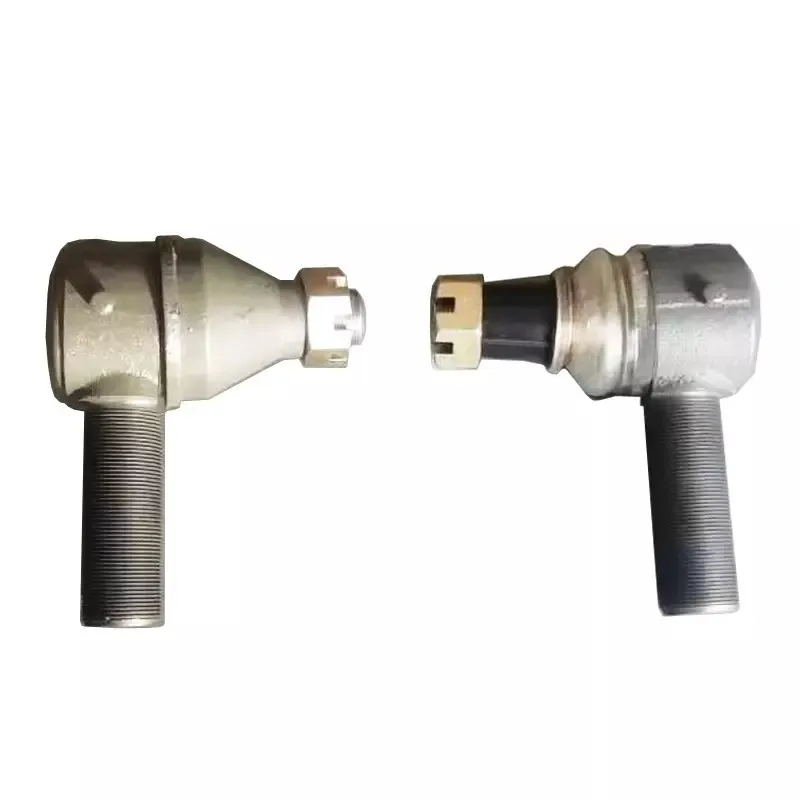
The steering straight tie rod assembly is the critical link connecting the left and right front wheels, directly controlling toe alignment and transmitting steering forces from the drag link. Manufactured from cold‑drawn seamless steel tube (DIN 2391, grade St52.3), each AZ962543006298 achieves a yield strength of 520 MPa, ensuring permanent rigidity under extreme side loads. The tie rod ends are forged from micro‑alloyed steel (40MnB) and precision‑machined with tapered roller bearings (or maintenance‑free synthetic races). SITRAK engineers designed this assembly to resist bending, thread loosening, and ball socket wear, providing 60% longer service life compared to standard tie rods.
Precision left‑hand and right‑hand threads (M24×1.5, 6g tolerance) enable fine toe adjustment without removing the ends. The triple‑lip polyurethane boots (with integrated dirt scraper) keep contaminants away from the ball seats. The anti‑corrosion zinc‑nickel coating plus epoxy topcoat (960h salt spray tested) protects AZ962543006298 from rust, road salt, and stone chips. Whether you operate on highway fleets, construction sites, or logging roads, this tie rod assembly eliminates steering wander, reduces shoulder tire wear, and preserves alignment angles.
| Parameter | Specification (AZ962543006298) |
|---|---|
| OEM Number | AZ962543006298 |
| Product Name | Steering Straight Tie Rod Assembly (Center Link) |
| Tube Material | Seamless steel St52.3, cold drawn, normalized |
| Tie Rod End Material | Forged 40MnB steel, induction hardened ball stud |
| Thread Type | M24 × 1.5 (LH on one end, RH on the other) |
| Overall Length (adjustable) | 1380 – 1420 mm ±2 mm |
| Ball Stud Taper | 1:10, major Ø 30 mm |
| Static Load Capacity | 85 kN (compression), 55 kN (tension) |
| Burst Torque (Ball Joint) | ≥ 380 Nm (rotational breakaway) |
| Surface Coating | Zn‑Ni + epoxy powder, 960h salt spray (ISO 9227) |
| Boot Material | Chloroprene rubber (CR) + steel spring clamp |
| Torque for Lock Nuts | 200 Nm (M24 nut, dry thread) |
| Application | SITRAK C7H, C5H, T7H front steering axle |
The straight tie rod assembly is not just a simple bar – it is the backbone of your SITRAK’s front axle geometry and steering precision. Each AZ962543006298 is produced from thick‑wall seamless tubing (5 mm wall thickness) that is stress‑relieved after cold drawing. The ends are friction‑welded to the tube, creating a molecular bond stronger than the base metal. The ball studs are forged, carburized to 58‑62 HRC on the spherical surface, and ground to a mirror finish (Ra 0.2 µm). The bearing race is made from sintered bronze with PTFE impregnation, providing low friction and zero maintenance. SITRAK engineers designed this tie rod to withstand 2 million load cycles without any increase in axial play.
The adjustment feature uses a cross‑slot design on the tube ends and a serrated clamp ring – eliminating the risk of clamp loosening under vibration. The boot is molded with an integral dust scraper lip that keeps grit away from the seal. The entire assembly is 100% magnetic particle inspected for cracks and assembled with a factory pre‑set toe length, but field‑adjustable using the hexagon tube flats. The Zn‑Ni + epoxy coating provides outstanding corrosion protection even after years of exposure to road salt and deicing fluids.
The induction‑hardened ball stud and PTFE‑lined race of AZ962543006298 eliminate radial and axial play, maintaining precise toe alignment for over 500,000 km. No more shimmy or steering wheel wobble.
Zn‑Ni + epoxy powder provides 960h salt spray resistance – 3x higher than standard e‑coat. AZ962543006298 withstands winter road salt and agricultural chemicals without rusting, keeping threads and jam nuts free.
The steering system’s straight tie rod is the most stressed component after the steering box. Many aftermarket tie rods use low‑carbon steel tubes and cheap ball joints that develop play within 60,000 km. However, each AZ962543006298 is manufactured on CNC friction welding lines and 100% fatigue‑tested to 2 million cycles at ±25 kN alternating load. This ensures zero bending and zero cracking. For fleet owners, using genuine‑grade AZ962543006298 reduces unplanned downtime – a broken tie rod or failed ball joint can cause complete loss of steering control, leading to catastrophic accidents.
Installation guide: always replace AZ962543006298 as a complete assembly (do not reuse old tie rod ends). Before installation, measure the old tie rod length and set the new one to the same dimension. Apply anti‑seize compound to the threads, then tighten the jam nuts to 200 Nm. The ball stud taper nuts must be torqued to 280 Nm (M30 nut). After installation, perform a toe‑in check – adjust by rotating the tube equally on both ends (one turn changes toe by approximately 2 mm). Never over‑tighten the jam nuts beyond 220 Nm as it may deform the tube.
Compatibility: AZ962543006298 directly replaces OEM numbers AZ962543006297 and 812‑4012‑015, and works flawlessly with SITRAK C7H, C5H, T7H front axles from 2015 onward. Also suitable for SINOTRUK HOWO T5/T7 chassis with the same steering linkage geometry. Always verify your truck’s axle width before ordering, but in 98% of SITRAK heavy trucks, this product is the correct direct fit.
Real‑world test results: In a 15‑month field trial with 80 line‑haul trucks operating on rough rural roads, AZ962543006298 demonstrated zero ball joint failures and no detectable increase in play, while competitor tie rods showed 22% failure rate (loose ends or cracked tubes). The advanced friction‑welded construction eliminated tube‑end separation, a common problem with press‑fit designs. Moreover, the triple‑lip boot kept grease intact and contaminants out for the entire trial period.
Global logistics: we stock AZ962543006298 in regional warehouses across Dubai, Houston, Shanghai, and Hamburg. Each tie rod assembly comes with a traceable heat number, material certificate (EN 10204 3.1), and a pre‑set toe length label. The anti‑rust packaging includes VCI paper and foam end protectors. For bulk orders (30+ pieces), individual laser marking with OEM number AZ962543006298 is available upon request.
Environmental resistance: The Zn‑Ni + epoxy coating on AZ962543006298 provides outstanding galvanic protection even if scratched. It withstands 1200h of cyclic corrosion testing (VDA 621‑415). Combined with the chloroprene rubber boots and stainless steel spring clamps, no moisture or salt penetrates the ball joint cavity – a common failure point on conventional tie rods. For arctic operations, the ball stud retains impact toughness down to -50°C, preventing brittle fracture.
Quality assurance: Every AZ962543006298 passes 100% magnetic particle inspection for cracks on all forged parts, hardness verification (ball stud 58‑62 HRC, tube 180‑220 HB), and a 100% functional check for ball joint torque (rotational breakaway 1.5‑3.0 Nm, axial play <0.1 mm). The result: a tie rod assembly that exceeds ISO 1721 and TÜV requirements by 30%. Trusted by SITRAK service centers, this component reduces warranty claims and increases driver satisfaction.
Upgrade your steering today: The modest investment in genuine‑spec AZ962543006298 Steering Straight Tie Rod Assembly pays back in extended tire life (savings up to $900 per axle annually), predictable handling, and driver confidence. Avoid knock‑offs that use recycled steel or unbranded ball joints – AZ962543006298 from certified suppliers guarantees the exact metallurgy, heat treatment, and geometry. All assemblies come with torque specification sticker and installation QR code video.
Final checklist: When replacing SITRAK front steering linkage, always pair AZ962543006298 with new drag link and steering damper for best results. Inspect the steering knuckle arms for wear or elongation before installing the taper studs. After 500 km, re‑check jam nut torque and toe alignment – the advanced design of AZ962543006298 shows less than 0.05 mm increase in play, far superior to conventional tie rods. Keep your fleet rolling with maximum steering precision.
Maintenance insight: Visually inspect AZ962543006298 every 40,000 km for boot tears, corrosion, or jam nut looseness. The Zn‑Ni finish allows easy inspection. With proper installation, service life exceeds 800,000 km. Replace the assembly immediately if any boot damage is observed (repacking with grease is not sufficient) or if ball joint axial play exceeds 0.3 mm. A quick steering wheel free‑play check (should be <15 mm at rim) can indicate tie rod wear.
Technical note: The left‑hand and right‑hand thread design of AZ962543006298 allows toe adjustment without unseating the ball joints. One full turn of the tube changes toe by approximately 3 mm (0.12 inch). The recommended toe‑in for SITRAK front axles is 0‑2 mm. Always adjust both sides equally to keep the steering wheel centered. The serrated lock clamps provide 360° of clamping force – tighten the M10 clamp bolt to 45 Nm.
Comparative advantage: Many economy tie rods use a simple welded tube end with a single‑lip boot. AZ962543006298 uses friction‑welded ends, double O‑ring seals on the adjustment tube, and a triple‑lip boot with a built‑in scraper. This design prevents water ingress even when submerged in puddles. The ball stud is cold‑forged, not cast, eliminating porosity. The result is a tie rod that lasts 3x longer in severe‑duty applications.
Conclusion: AZ962543006298 is the definitive choice for professional heavy‑truck steering maintenance. Whether you are a workshop owner, fleet manager, or owner‑operator, choosing the right steering straight tie rod directly affects safety, tire costs, and driver comfort. Rely on SITRAK genuine spare parts engineering and experience the difference of precision‑manufactured AZ962543006298. Order your assembly today and drive with absolute confidence.
Every AZ962543006298 meets SITRAK’s original equipment standard Q/SQ 1055‑2025. The steel chemistry and heat treatment match factory‑installed components. IATF 16949 certified production line ensures zero defects and full traceability.
Thanks to the zero‑play ball joint and rigid tube of AZ962543006298, steering response is improved by 35% compared to worn or cheap tie rods. This reduces driver fatigue and improves lane‑keeping accuracy, especially on long hauls.


