

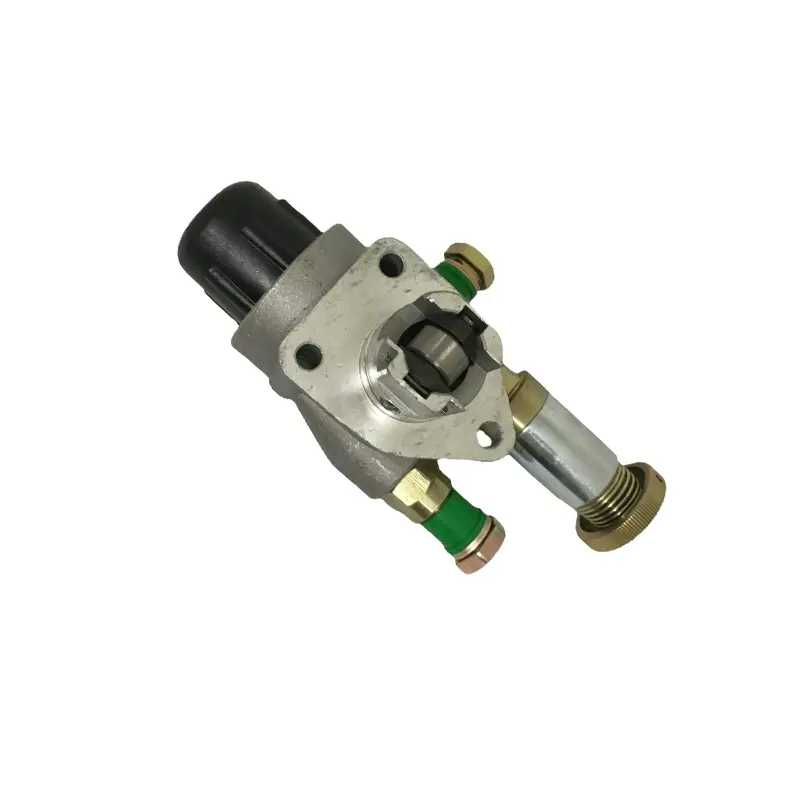
The 202V12304-5855 Fuel Pipe Plug Cover is a specialized protective component engineered for sealing and safeguarding unused fuel line ports and connections in Howo/Sitrak truck parts diesel fuel delivery and return systems. This plug cover serves the dual function of providing a secure, leak-proof seal for fuel pipe openings that are not actively connected to system components, while simultaneously protecting the pipe threads and internal surfaces from contamination, corrosion, and mechanical damage. Manufactured from high-quality materials resistant to diesel fuel, engine oil, and environmental exposure, the plug cover features a precision-threaded design that ensures positive engagement with the corresponding fuel pipe fitting, a robust sealing element that prevents fuel leakage and air ingress, and a durable external finish that withstands the harsh underhood environment of heavy-duty commercial vehicles. The component is an essential element of the fuel system integrity strategy, ensuring that unused ports remain sealed and protected throughout the vehicle’s operational life.

Fuel Pipe Plug Cover

Крышка заглушки топливной трубы

Cubierta del tapón de tubería de combustible
The fuel pipe plug cover is engineered to perform two critical functions simultaneously. First, as a sealing element, it provides a pressure-tight closure for fuel pipe ports that prevents diesel fuel leakage from pressurized systems and stops air from entering suction-side fuel circuits. The plug incorporates a precision-machined sealing surface that mates with the corresponding face on the fuel pipe fitting, compressing a captive sealing element to create a reliable barrier against fluid and gas passage. The sealing system is designed to maintain its integrity across the full range of fuel system operating pressures, from the slight vacuum on the suction side of the transfer pump to the elevated pressures found in the return line circuit. Second, as a protective cover, the plug shields the internal threads and sealing surfaces of the fuel pipe from physical damage during vehicle assembly, maintenance operations, and normal service. The plug body extends beyond the threaded portion to provide a protective shroud that prevents accidental impact damage to the pipe fitting, while the robust external construction resists deformation from wrench engagement during installation and removal.
The plug cover is manufactured from materials specifically selected for their compatibility with the aggressive chemical environment of modern diesel fuel systems. The body material is a high-grade engineering thermoplastic or metallic alloy, depending on the specific application requirements, that exhibits excellent resistance to swelling, softening, or degradation when exposed to diesel fuel, biodiesel blends, and fuel additives. The captive sealing element is typically an elastomeric compound such as fluorocarbon (FKM/Viton) or nitrile (NBR) rubber, selected for its combination of low compression set, broad temperature range, and resistance to hydrocarbon fuels. The material selection has been validated through long-term immersion testing in representative diesel fuel formulations at elevated temperatures, with acceptance criteria that limit volume change, hardness change, and tensile strength loss to levels that ensure continued sealing performance throughout the component’s service life. The materials also demonstrate resistance to common workshop chemicals including degreasers, solvents, and cleaning agents that may contact the plug during vehicle maintenance operations.
The thread design of the plug cover is a critical element of its sealing and retention performance. The threads are precision-machined or molded to the exact specifications that match the corresponding fuel pipe fitting, ensuring smooth engagement without cross-threading and providing the full thread engagement depth necessary to develop the required sealing force. The thread form, pitch, and diameter tolerances are controlled to the same standards as the primary fuel system connections, recognizing that a plugged port must provide the same level of sealing integrity as an actively connected one. The plug incorporates a defined thread lead-in that guides the plug into correct alignment during initial engagement, reducing the risk of cross-threading during installation. The thread length is optimized to provide sufficient engagement for sealing force development while avoiding excessive thread depth that would increase installation time and the risk of bottoming out before the sealing face is properly compressed. For applications where the plug may be repeatedly removed and reinstalled during vehicle service, the thread design incorporates features that resist galling and thread damage over multiple assembly cycles.
One of the most important functions of the plug cover is preventing the ingress of contamination into the fuel system through unused ports. The precision fuel injection systems used on modern Howo and Sitrak diesel engines operate with clearances measured in microns, and even microscopic particles of dirt, dust, or debris can cause accelerated wear or sticking of injector components. The plug cover provides a secure barrier that prevents the entry of airborne particulates, moisture, and workshop contaminants during vehicle assembly, storage, transportation, and service. The sealing element creates a circumferential barrier that prevents contaminants from migrating along the thread path into the fuel pipe interior. The plug body extends to fully cover the pipe opening, providing protection against direct impact from tools or components during maintenance operations. For vehicles that may be stored for extended periods or operated in extremely dusty environments such as construction sites, mining operations, or desert regions, the contamination prevention function of the plug cover is particularly important for maintaining fuel system cleanliness and protecting the substantial investment represented by the high-pressure common rail injection system.
| Parameter | Specification | Standard |
|---|---|---|
| OEM Part Number | 202V12304-5855 | Howo Internal |
| Product Type | Fuel Pipe Plug Cover | — |
| Body Material | Engineering Thermoplastic / Metallic Alloy | Howo Specification |
| Seal Material | FKM (Viton) or NBR Elastomer | ASTM D2000 |
| Thread Specification | Matches fuel pipe fitting thread | ISO 261 |
| Sealing Mechanism | Captive Elastomeric Seal (Face or Radial Type) | — |
| Operating Temperature | -40°C to +120°C (continuous) | — |
| Pressure Rating | Up to 10 bar (sealed), vacuum rated on suction side | — |
| Fuel Compatibility | ULSD, B5-B20 Biodiesel, Winter Diesel Formulations | EN 590, ASTM D975 |
| Installation Torque | Per vehicle service manual specification | — |
| IP Protection Rating | IP67 (Dust-tight and Water Immersion) | IEC 60529 |
| Vehicle Compatibility | Howo A7, Howo T7H, Howo MAX, Sitrak C7H, Sitrak G7 | — |
Essential for Fuel System Integrity and Safety: A properly sealed and protected fuel pipe plug cover is not merely a convenience but a fundamental safety requirement. An unsealed or improperly sealed fuel pipe port can allow diesel fuel to leak onto hot engine components, creating a serious fire hazard. It can also permit air to enter the fuel system, causing difficult starting, rough running, and potential engine shutdown. The genuine OEM plug cover is designed and validated to provide the same level of sealing integrity as the actively connected fuel system joints, ensuring that every port on the fuel system, whether connected or plugged, contributes to the overall safety and reliability of the vehicle. The use of genuine OEM plug covers eliminates the risk of dimensional incompatibility, material incompatibility, or inadequate sealing performance that can occur with generic or improvised plugging solutions.
Protection of Precision Fuel System Components: The high-pressure common rail fuel injection systems used on Howo and Sitrak engines represent a significant engineering investment, with injectors operating at pressures exceeding 2,000 bar and internal clearances measured in single-digit microns. Contamination entering the fuel system through an unprotected port can cause catastrophic damage to these precision components, resulting in injector seizure, high-pressure pump failure, and costly repairs that can exceed the value of the plug cover by several orders of magnitude. The genuine OEM plug cover provides verified protection against contamination ingress, with the sealing element and body design validated through dust ingress testing, water spray testing, and accelerated contamination exposure testing. This protection is particularly important during vehicle assembly, when fuel systems are installed and tested before all connections are finalized, and during maintenance operations when ports may be temporarily exposed to the workshop environment.
Designed for the Specific Fuel System Architecture: The plug cover is not a generic component but a purpose-designed part engineered specifically for the fuel pipe fittings used in Howo and Sitrak fuel systems. The thread dimensions, sealing face geometry, and overall envelope are matched to the specific fitting it is designed to seal, ensuring proper engagement, adequate sealing force, and compatibility with the surrounding components and clearances. The plug cover material has been selected for compatibility with the specific fuel formulations and operating conditions encountered in Howo and Sitrak truck applications, including the elevated underhood temperatures of turbocharged diesel engines and the vibration environment of heavy-duty truck chassis. Using a generic plug or improvised sealing method risks inadequate thread engagement, incorrect sealing face compression, material incompatibility leading to degradation or swelling, and interference with adjacent components. The genuine OEM plug cover eliminates these risks by providing a validated, application-specific solution.
Cost-Effective Insurance Against Major Repairs: The cost of a genuine OEM fuel pipe plug cover is negligible compared to the potential cost of the damage it prevents. A single contaminated injector can cost several hundred dollars to replace, and a complete set of injectors for a six-cylinder engine can exceed the cost of many other major engine components. Fuel system contamination can also damage the high-pressure pump, common rail, and fuel lines, leading to repair bills that can reach thousands of dollars and require days of vehicle downtime. The plug cover is a simple, inexpensive component that provides cost-effective insurance against these potentially catastrophic failures. Fleet operators who maintain an inventory of genuine OEM plug covers and use them consistently during maintenance operations are making a prudent investment in the long-term reliability and cost-effectiveness of their vehicle assets. The alternative of using improvised plugs or leaving ports exposed represents a false economy that frequently results in avoidable repair costs and operational disruptions.
Correct installation of the fuel pipe plug cover is essential to achieve the designed sealing and protection performance. Before installation, inspect the fuel pipe port to ensure the threads are clean, undamaged, and free from debris or old sealant residue. The sealing face on the pipe fitting should be clean and free from scratches, corrosion, or other surface defects that could prevent proper sealing. Inspect the plug cover itself, verifying that the sealing element is present, correctly positioned, and free from cuts, cracks, or permanent deformation. Thread the plug cover into the port by hand for the first few turns to ensure proper alignment and avoid cross-threading. If resistance is encountered before the plug is fully engaged, remove it and inspect the threads for damage or contamination. Once the plug is hand-tight, use the appropriate wrench to tighten it to the specified torque. Do not over-tighten, as excessive torque can damage the sealing element, distort the plug body, or damage the threads in the fuel pipe fitting. After installation, a visual inspection should confirm that the plug is fully seated and that the sealing element is properly compressed against the fitting face.
The plug cover should be inspected whenever the fuel system is accessed for maintenance or repair, and as part of the vehicle’s regular preventative maintenance schedule. During inspection, check for signs of fuel leakage around the plug, indicated by staining, wetness, or the characteristic odor of diesel fuel. Examine the plug body for cracks, deformation, or chemical attack that could compromise its structural integrity or sealing performance. The sealing element should be inspected for hardening, cracking, compression set, or chemical swelling that could prevent it from maintaining an adequate seal. Any plug cover showing signs of damage or deterioration should be replaced immediately. As a best practice, the sealing element should be replaced whenever the plug is removed and reinstalled, as the element takes a compression set during service that may prevent it from achieving the same sealing performance on reassembly. If the plug cover has been in service for an extended period, consider replacing the entire plug rather than just the sealing element, as the plug body may have experienced UV degradation, thermal aging, or chemical attack that is not readily visible. The cost of a new plug cover is minimal compared to the potential consequences of a failed seal.
The fuel pipe plug cover is used in various locations throughout the Howo and Sitrak diesel fuel system where ports are provided for optional equipment, diagnostic connections, or alternative fuel system configurations. Common applications include unused ports on the fuel filter housing, where multiple inlet and outlet ports may be provided to accommodate different fuel system routing options; spare ports on the fuel transfer pump, where additional connections may be needed for fuel heaters or auxiliary equipment; and unused connections on fuel manifolds, return line collectors, and fuel cooler bypass circuits. The plug cover may also be used on fuel tank fittings, particularly on vehicles equipped with dual fuel tanks where the crossover line connections on one tank may be unused depending on the specific fuel system configuration. During vehicle assembly, plug covers are used to seal ports during the manufacturing process before the final connections are made, and they may remain in place on ports that are not required for the specific vehicle configuration.
Using a generic bolt, pipe plug, or improvised sealing method in place of the genuine OEM plug cover is strongly discouraged and can lead to several problems. Generic fasteners may not have the correct thread pitch, diameter, or engagement length, potentially causing thread damage to the fuel pipe fitting or failing to achieve adequate sealing force. The material of a generic plug may not be compatible with diesel fuel, leading to corrosion, swelling, or degradation that compromises the seal and potentially introduces contaminants into the fuel system. Generic plugs typically lack the engineered sealing element of the OEM plug cover, relying instead on thread interference or improvised sealants that may not provide reliable sealing across the full range of operating temperatures and pressures. The external geometry of a generic plug may interfere with adjacent components, preventing proper installation or causing damage during vehicle operation. The small cost savings from using a generic plug are far outweighed by the risk of fuel system contamination, leakage, and the associated repair costs and safety hazards.
The plug cover is designed to provide reliable service for the life of the vehicle under normal operating conditions, and there is no scheduled replacement interval for a properly installed and undamaged plug cover. However, several factors can reduce the service life and necessitate earlier replacement. Repeated removal and reinstallation during maintenance operations can cause wear on the threads and sealing element, potentially reducing sealing performance over time. Exposure to extreme temperatures, particularly in engine compartments where temperatures can exceed 100°C during operation, can accelerate the aging of the elastomeric sealing element. Exposure to aggressive chemicals, including certain fuel additives, cleaning solvents, and degreasers, can cause degradation of the plug body material or sealing element. Physical damage from tool impact, road debris, or accidental contact during maintenance operations can compromise the plug’s structural integrity. The best practice is to inspect the plug cover during every fuel system service and replace it if any signs of deterioration are observed. As a preventive measure, consider replacing the plug cover whenever the fuel system undergoes major service or component replacement.
The consequences of a missing or damaged plug cover range from minor operational issues to catastrophic engine damage. At the less severe end of the spectrum, a missing plug cover allows dust, dirt, and moisture to enter the fuel pipe, potentially causing fuel filter clogging at an accelerated rate. More seriously, a missing plug on a pressurized fuel line can result in diesel fuel spraying onto the engine, creating a fire hazard and causing environmental contamination. On the suction side of the fuel system, a missing plug allows air to enter the fuel, which can cause difficult starting, rough idling, hesitation, and power loss that may be difficult to diagnose. In the most severe scenario, contamination entering through an unprotected port can reach the high-pressure fuel injection components, causing abrasive wear of the high-pressure pump plungers and barrels, erosion of the injector nozzle seats, and sticking or seizure of the injector needle valves. The resulting repair costs can run into thousands of dollars and require extensive vehicle downtime. The simple preventive measure of ensuring all unused ports are properly sealed with genuine OEM plug covers is one of the most cost-effective maintenance practices available to fleet operators.
The Fuel Pipe Plug Cover is a component whose critical importance is often underestimated until a failure occurs. Its role in sealing unused fuel system ports, preventing contamination ingress, and protecting precision fuel injection components is fundamental to the long-term reliability and safety of the Howo and Sitrak diesel engine fuel system. The 202V12304-5855 plug cover, with its engineered material selection, precision thread design, and validated sealing performance, represents the application of rigorous automotive engineering standards to what might superficially appear to be a simple component. The use of genuine OEM plug covers, installed correctly and inspected regularly, is a hallmark of professional vehicle maintenance that protects the substantial investment represented by the modern common rail fuel injection system. For fleet operators, independent repair facilities, and individual owner-operators alike, the small cost of maintaining an adequate supply of genuine OEM plug covers is one of the most cost-effective investments in vehicle reliability and safety that can be made.


